A few weeks ago, we drove up to Cologne (or Koln, as the locals know it) for the day. I was super excited about this one!
So get this...Koln was founded by the Romans in the first century A.D. That's less than one hundred years after the birth of Christ. If that doesn't make you shake your head in wonder, I really don't know what will! During the Middle Ages, the city flourished as a major transport hub, given its location on the Rhine River. Cologne suffered almost complete destruction during World War II as one of the most heavily bombed cities in Germany.
I found the photo below online of bomb-ruined Cologne in 1945. Both bridges were destroyed, including the railroad bridge (the one on the left directly behind the cathedral).
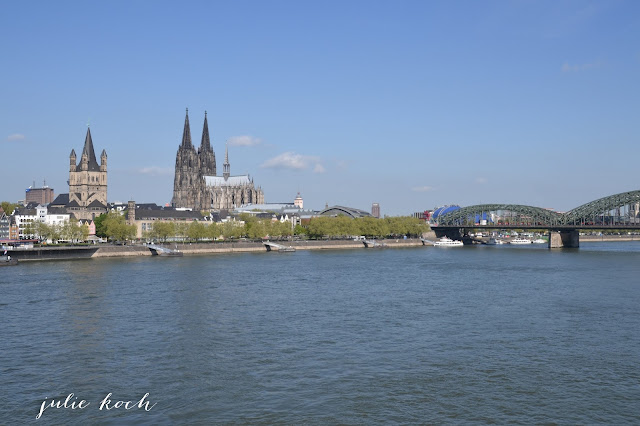 |
| From left to right: Groß St. Martin, Cologne Cathedral (or Kölner Dom), and the railroad bridge. I took this photo as we crossed the Rhine on another bridge to reach the city. |
 |
| These colorful buildings face the river. So pretty! |
First order of business was lunch! After that, we went to check out Groß St. Martin. I know I've mentioned this in a previous post, but the "ß" that you see in a lot of German words is just short for "ss". So in this case, you'd say this church's name Gross St. Martin, and gross in German means "great" or "large". Anyway, this place was pretty cool and full of history.
The church's foundation, which dates back to 960 A.D., sits atop remnants of an old Roman chapel. It later became a Benedictine monastery. The current structure (or what existed before WWII) was built between 1150-1250 A.D. In May of 1942, after an air raid, the tower and nave burned completely to the ground. Then in 1943, the church was bombed again and suffered even more damage. In 1945, whatever wasn't previously hit was destroyed, leaving very little of the structure behind. I found this photo online showing what the church looked like in 1946:
After the War, the subject of whether or not to rebuild Groß St. Martin was a debate among the people of Cologne, as some felt that the ruins should be left as they were as a memorial. Restoration, however, began in 1948 and wasn't finished until 1984. It was during excavation in the 1960's that the multiple foundations (that I mentioned above) were discovered and the extent of the building's history was pieced together.
Standing inside the sanctuary, it was obvious where the older stonework met the newer part.
We also went into the basement area where the original site was excavated as mentioned above. I didn't take any pictures down there as it was pretty dark, but Rich got this one of a blurry me checkin' it all out:
Next, we strolled through town taking in all the interesting things along the way.
We made our way to the famous Cologne Cathedral, or Kölner Dom. It, too, was severely damaged during World War II, but it remained standing. The beginning stages of construction took place from 1248 to 1473 A.D., and even then it wasn't finished. Work began again during the 19th century and was completed in 1880. The cathedral has the largest façade of any other church in the world. And another bit of interesting history? The Three Wise Men, as in the ones who visited Jesus at his birth, are believed to be enshrined here.
And now, I will unapologetically overwhelm you with photos.
 |
| Do you see all the intricate carvings? |
 |
| Here's a closer look. Absolutely amazing. |
 |
| And the obligatory photo of a pigeon on a statue's head. |
 |
| View from the altar looking back toward the entrance. |
 |
| Shrine of the Three Kings |
 |
| Shrine of the Three Kings |
 |
| Hard to tell, but the floor is a huge mosaic made from tiny tiles. |
We exited the cathedral and decided to cross the railroad bridge to get back across the river where we parked. As we rounded the backside of the cathedral, I noticed that there are TONS of spires to be seen from this view!
And also, a statue of a woman playing a guitar. What?!
 |
| Railroad bridge. |
 |
| The railroad bridge also serves as one of the many love lock bridges we've seen in Europe so far! We want to add our own lock at some point, but we're never prepared at the right time! |
 |
| These statues of men on horses flank each of Cologne's bridges. |
 |
| One last look before leaving. |
Our opinion of Cologne? A definite must-see with tons of history.
At this point, we drove west into the Netherlands to Margraten to visit the Netherlands American Cemetery. Rich had already been here back in January when I was in Georgia. His Air Force group had driven over to do a clean-up, and I was disappointed that I'd missed it.
Nazi Germany had invaded the Netherlands in 1940 and occupied the country until 1945 when it was liberated by Allied forces. When Rich had visited the cemetery before, his group had been given a tour of the grounds by a local Dutch volunteer. He explained how appreciative the people still are for those brave troops who freed them. There is a nearby Dutch military base, and they march all of their basic training troops to the cemetery to pay their respects to the Americans who gave their lives for their liberation. Local people have adopted graves to keep clean and maintain, and the waiting list for doing this consists of a couple thousand people.
When I was six years old, my parents took us to Washington, DC. Even though I was very young, I still have extremely vivid memories of this trip. I remember looking at my reflection in the Vietnam Memorial, and I was very concerned about why my Mom cried there for so long--her cousin, Tommy, lost his life in Vietnam in 1967 at the age of 19. I also remember asking Daddy why there were so many American flags around the Washington Monument. That was my first experience of what patriotism felt like.
With that being said, there is something that stirs deep inside my heart to stand in another country, on another continent, so very far away from home, and see our flag flying high in the wind. I can't even type this without tearing up. It's an incredible sight. And this cemetery is a beautiful place of honor and remembrance that I wish every American could see.
 |
| Court of Honor |
 |
| The statue is meant to represent a mother grieving for her lost son. |
 |
| The graves of 8,301 souls cover almost 66 acres. |
When we signed the guest book, I noticed that the name just above ours was a former U.S. military member from Thomasville, Georgia. I tried to spot the guy on the grounds, but unfortunately never did.
After leaving the cemetery, we ventured just a little further west into the town of Maastricht, Netherlands. It isn't clear when Maastricht was settled, or whether or not it was the Romans who did so, but the Romans did build a bridge here over the Meuse River during the first century A.D. The city's first medieval walls were built surrounding the city in the 13th century. In 1944, Maastricht was the first Dutch city liberated by the Allies.
 |
| These streets look like they're straight out of a painting. |
 |
| Town hall. |
 |
| Another obligatory photo of a pigeon on a statue's head. |
We didn't stay in Maastricht very long, but we did enjoy some delicious eis creme. I had lemon...very tart but fantastic! We'll likely visit again in the future.
Hope you enjoyed this adventure!